Within This Page
Introduction
Process is critical to successful, balanced designs; and a key step in the design process is an integrated design charrette. In this Resource Page, a charrette is defined as an intensive workshop in which various stakeholders and experts are brought together to address a particular design issue, from a single building to an entire campus, installation, or park. The term can also be applied to shorter, focused project team meetings, project planning meetings, brainstorming sessions, and extensive community visioning events.
A charrette can be the mechanism that starts the communication process among the project team members, building (or campus) users, and project management staff. As such, it is important that all relevant decision makers attend. Furthermore, a charrette can be viewed as a creative burst of energy that builds momentum for a project and sets it on a course to meet project goals. It can transform a project from a static, complex problem to a successful, buildable plan. Usually, it is an intensely focused, multi-day session that uses a collaborative approach to create realistic and achievable design ideas that respond successfully to the issues at hand.
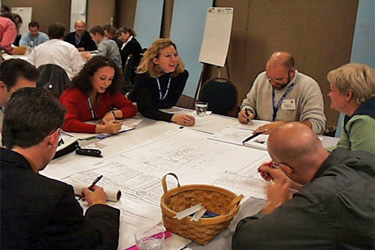
Participants in the charrette work groups discuss the project's environmental priorities using the LEED® Green Building Rating System. Charrette for Southface New Office Building.
Photo Credit: Paul Torcellini
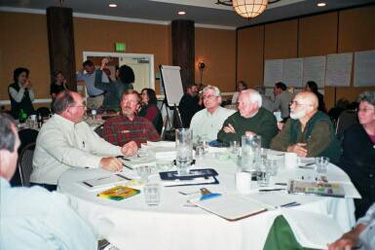
Charrette work groups work at round tables in a large meeting room—note the flip chart pages taped to the walls. San Francisco Maritime National Historic Park Greening Charrrette.
Photo Credit: Joel Todd
Charrettes have been used by planning and design teams for many years. Approximately 15 years ago, sustainability issues were added to the topics emphasized during charrette sessions. Three highly visible and successful charrettes held in the early 1990s—the Greening of the White House, the Greening of the Grand Canyon, and the Greening of the Pentagon—focused attention on the use of charrettes as part of an integrated design process with a focus on sustainability. Nowadays, numerous federal, state, and local government agencies, military bases and installations, nonprofits, and private-sector owners use the charrette process for integrated, 'whole building', design issues, as well as specific focuses like sustainability and security. For more information on the 'whole building' approach, see WBDG Whole Building Design.
As experience in conducting charrettes has grown, "lessons learned" have been gathered into a handbook to assist others in planning and conducting these events. This handbook, A Handbook for Planning and Conducting Charrettes for High-Performance Projects , contains detailed checklists and tips, along with a step-by-step process for planning, implementing, and following-up on the charrette. This process is summarized in this Resource Page.
Description
A. Purposes and Benefits of Integrated Design (ID) Charrettes
Integrated, or 'whole building', charrettes establish a creative environment for identifying and incorporating strategies that result in projects that are designed and built to minimize resource consumption, reduce life-cycle costs, and maximize health and environmental performance across a wide range of measures—from indoor air quality (IAQ) to habitat protection—while also meeting expectations for security, accessibility, aesthetics, historic preservation, and other design objectives. There are many benefits of using charrettes early in the design process. Most importantly, charrettes can save time and money while improving project performance. In general, integrated design (ID) charrettes:
- Provide a forum for planning the project with those who can influence design decisions to make sure early decisions avoid missteps—it is easier to set a course than to change it.
- Provide an opportunity for lessons learned from previous projects to inform the planning process.
- Kick off the design process.
- Encourage agreement on project goals.
- Save time and money by collaborating on ideas, issues, and concerns early in the design process to help avoid later iterative redesign activities.
- Promote "collective enthusiasm" for a project with early realistic goals and directions.
Conducting an ID charrette early in the design/decision-making process will:
- Establish a multidisciplinary team that can set and agree on common project goals. See also WBDG Design Disciplines for information on the roles and responsibilities of each design discipline in the 'whole building' design process.
- Develop early consensus on project design priorities.
- Generate early expectations or quantifiable metrics for final energy and environmental outcomes.
- Provide early understanding of the potential impact of various design strategies.
- Initiate a design process to reduce project costs and schedules, and obtain the best energy and environmental performance.
- Identify project strategies for exploration with their associated costs, time constraints, and the needed expertise to eliminate costly "surprises" later in the design and construction processes.
- Identify partners, available grants, and potential collaborations that can provide expertise, funding, credibility, and support to the project.
- Set a project schedule and budget that all team members feel comfortable following.
Conducting regular follow-up and feedback as the project progresses after the ID charrette can:
- Ensure that the team continues to work together toward attaining their shared goals.
- Provide opportunities for discussion of more specific alternatives.
- Ensure continual involvement of the initial core participants.
B. Key Issues in Planning and Implementing an ID Charrette
Before You Begin to Organize Your Charrette, You Must Be Clear About Your Goals for the Event – What Do You Hope to Achieve?
Expectations can include:
- Consensus on project goals
- Identification of realistic strategies and designs for the project
- Consensus on time frames and champions associated with goals
- Ideas of potential partners and funding sources for a project
- Shared information and "lessons learned" from experts
Once your goals are clear, you should ask a few questions to make sure your charrette will be most effective: (If you can answer yes to these questions, you are ready to proceed.)
- For a building, is the project program developed? See WBDG Architectural Programming. Do you know what functions are to be performed, needs of occupants, special requirements? Has the site been selected or narrowed to a few possibilities? (It is best to hold the charrette during the project planning cycle if possible, once the project team is in place.)
- For large-scale projects, such as campuses, military bases, or other developments, are issues to be addressed in the charrette well defined? These issues could include overall master planning, transportation, facilities construction or renovation, operations and maintenance, green procurement and contracting, and education and outreach.
- Are there staff or volunteers and resources to support the event?
- Is there an overall organizer, or "facilitator," to lead the effort?
To Be Most Effective and Efficient in Planning a Charrette, Include the Following Activities:
Note: The schedule and process outlined below are designed for a charrette that will include outside stakeholders, partners, and experts as well as the project team; a smaller charrette for the project team only would require less time and the process will be simpler.
1. At least 3 months before the event...
- Create a Steering Committee: The first step in planning and organizing a charrette is to set up a steering committee. The purpose of the steering committee is to guide the charrette planning process and ensure support from key individuals and organizations. Discussing the charrette objectives and logistical issues with several enthusiastic and dedicated people will stimulate the generation of ideas and make the charrette a more successful event. A small group of five to eight individuals working closely together will enhance the efficiency of the charrette planning process. In general, everyone who will be involved in making the charrette happen, including logistical support, should be included.
- Hold a kickoff meeting: Use the kickoff meeting of the steering committee to begin shaping the event. End the kickoff meeting with a review of charrette purpose and goals. Begin to address the following in general terms during an initial kickoff meeting and in more detail in subsequent meetings:
- Date and location for the charrette
- Purpose of the charrette
- Products resulting from the charrette
- Agenda for the charrette
- Resources needed to help cover or defray costs of the charrette
- Participants to invite to the charrette
- Speakers to provide the desired motivation and expertise during the charrette
- Facilitators to lead the charrette and breakout groups
- Partners to supply resources and/or buy into the charrette process and its results
- Project information for charrette participants
- Date, time, and logistics of the next steering committee meeting.
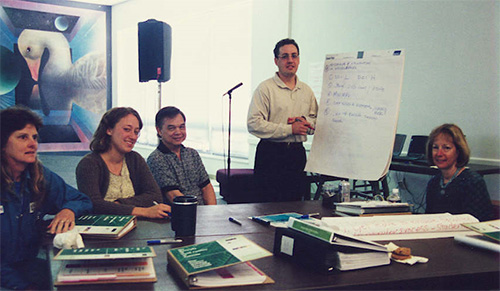
Charrette work group participants work with the facilitator to capture ideas on flip chart. Charrette for the University of North Carolina Science Building.
Photo Credit: Gail Lindsey, FAIA
2. Two to three months before the event...
-
Develop an Agenda: The agenda should include welcome and introductions, opportunities for VIPs to welcome the group and state support of goals, an overview of the project and goals for the charrette, presentations by experts to support the work to be done, and facilitated small groups with carefully crafted report-out sessions.
-
Confirm Availability of Key Event Players: Key players will include an overall facilitator for the event, facilitators for small work groups, VIPs to lend credibility and support to the event, experts to serve as resources for the work groups and to make brief presentations to the whole group, and most critically-participants.
-
Finalize Speaker List and Provide Presentation Guidelines: Give speakers clear guidance including length of their talk, purpose, level, and intended content. Plan enough time so that you can review a draft of each speaker's presentation prior to the charrette to ensure that each talk is on target and can be done in the time allotted.
-
Invite Participants and Track Responses: Participants should include the project team, building or campus users, other stakeholders and partners, and other specific people or organizations related to the project. Include those responsible for security, accessibility, aesthetics, historic preservation (if applicable), and other concerns. Invite decision makers, those who can commit to action during the charrette. A group of 25 to 50 is ideal; more than 50 is unwieldy and fewer than 25 reduces the number of work groups that can be established. Send a "Save the Date" card to potential participants as soon as the date is chosen, then send invitations when the agenda and other logistics are final. Consider developing and sending out a preliminary questionnaire for completion and submission prior to the charrette. The preliminary questionnaire can cover many time-consuming issues, allowing for more time to focus on critical issues identified in the questionnaire during the actual charrette.
- Finalize Budget: Potential costs to be included in the budget can include:
- Mailings (flyers, e-mails, invitation letters)
- Charrette materials and reproduction (including pre-design energy analysis)
- Speakers' and facilitators' time and travel
- Staffing support for the event, including photographers and writers
- Facility rental
- Food
- Audiovisual (AV) equipment
- Internet connection at the facility (optional)
- Final charrette report and follow-up with participants.
Funding for participation in the charrette should be included in contractor budgets, if possible.
-
Make Logistical Arrangements: Logistical arrangements will include a facility for the event, food, staffing, equipment and supplies, signs, name badges, and exhibits of local green building businesses (optional).
-
Assemble Participant and Resource Materials: All material for participant packets should be identified and collected for assembly and distribution (materials could include agenda, participant list, copies of the presentations, project information, and other pertinent resource materials). Other resource materials that would be beneficial to participants during the charrette should be identified (materials could include books, computer programs; and project site materials such as aerial photos, topographic plans, hydrology drawings, wind roses, existing vegetation); and steering members should determine how these resources will be made available to participants during the charrette.
-
Develop Evaluation Forms: Charrette feedback is essential. Determine feedback needed that would help the project and similar future efforts and create a form that could be given to participants at the charrette. Usually one page (front and back) should be adequate. (Leave room at the end for open feedback.)
To Be Most Effective and Efficient in Conducting a Charrette, Include the Following Activities:
1. The day before the event...
-
Visit the Facility: Before the event, double check everything at the facility - especially audio-visual equipment, lighting, and if applicable, security measures at the facility.
-
Check Supplies and Participant Materials: The day before the event, check charrette supplies (flip charts, markers, tape, name badges, drawing supplies if needed, etc.); review all participant packets (check that all have the appropriate materials and are complete packets). If other resources have been delivered, check those and determine how they will be made available to participants (resource table, computer access, etc.).
-
Meet with the Facilitator and the Speakers: Meet with facilitators and speakers to make sure everyone understands their roles, the schedule, and the ultimate goals for the day. Load all speaker presentations on a single laptop to prevent pauses between speakers. Make sure the recorder(s) understand the types of notes to take and assign him/her responsibility for organizing and collecting all chart paper at the end of the event.
2. The day of the event...
- Verify Logistical Arrangements: Check the room for audio, lighting, seating arrangements, and tables for resource materials. Rearrange seating and other elements as necessary. Determine the most effective room layout for presentations as well as break-out groups (sometimes additional rooms are desired for break-out groups but a single room allows the larger group to feel "connected" if the noise is not too great). Also, check on food that may be part of the room logistics.
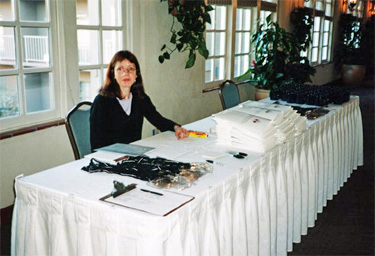
Sign-in desk with participant sign-in sheet, name badges, participant notebooks, and participant "mugs" (no styrofoam cups!). Bandelier National Park Greening Charrette.
Photo Credit: Joel Todd
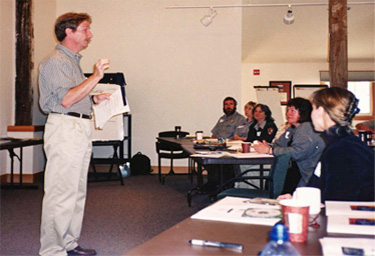
Don Neubacher, Point Reyes Superintendent, welcomes charrette participants and "sets the stage" for the critical park issues as well as the global environmental issues. (Welcoming remarks by a top project team member is extremely helpful for charrette "buy-in".) Point Reyes National Seashore Greening Charrette.
Photos Credit: Joel Todd
-
Set the Stage with the opening sessions and describe project and charrette expectations: In the opening sessions, make sure the goals and expectations for the event are clear to participants. A welcome from a "top level project team member" endorsing the charrette and sharing project goals is extremely helpful.
- Establish Ground Rules for the Charrette: Ground rules allows for the group to remain focused while encouraging the free flow of ideas. Examples of ground rules include:
- No criticism of ideas or people
- Respect everyone's time
- All ideas are good
- Everyone participates
- Final decisions are consensus based
- No cell phones
- One conversation at a time
-
Arrange for a Site Visit, if Applicable: A site visit allows charrette participants to understand site opportunities and challenges, which will be taken into account when alternatives are developed during the charrette.
-
Create Effective Breakout Groups: During the charrette, use tested practices, including designated facilitators, to ensure effective breakout groups. Allow the groups to interact during their working sessions - "cross-pollination" is a source of new ideas. Breakout groups are most effective if there are 6-8 members in a group. (However, groups of 3-10 can be effective.)
-
Implement Successful Charrette Practices: Allow plenty of time for reporting out and discussion of various ideas. Also, allow for clear concise wrap-up and next steps - especially helpful are "last thoughts and insights" from a top level team member to catalyze the group to reach their charrette project goals.
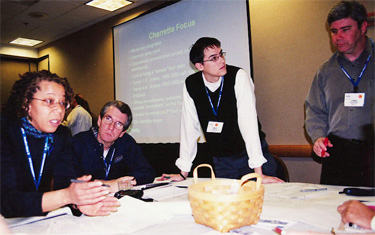
Charrette work group participants discuss "Charrette Focus" issues as defined by the Steering Committee. Charrette for Southface New Office Building.
Photo Credit: Gail Lindsey, FAIA
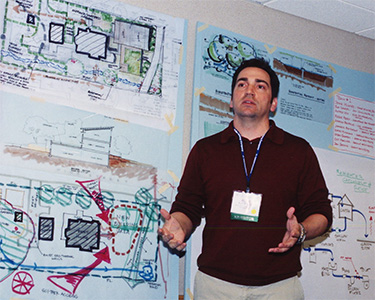
Leader for one of the charrette work groups "reports out" on the environmental goals, strategies, and concepts for the new office building for Southface. Charrette for Southface New Office Building.
Photo Credit: Gail Lindsey, FAIA
To Be Most Effective and Efficient in the Follow-Up After a Charrette, Include the Following Activities:
1. Within a month following the charrette...
-
Hold a Debriefing Meeting: At a minimum, the charrette steering committee should hold a debriefing meeting to discuss "next steps" after the event and feedback from the evaluation forms. A schedule for further feedback and updates could be discussed.
-
Prepare a Report on the Results: An immediate, short (1–2 page) executive summary with photos is an excellent tool to "spread the word" about the charrette - both the process as well as the top priority issues and goals set during the charrette. In addition, a longer charrette report (25-35 pages) could describe the action items, team members, visions, etc. of the charrette. Both reports are extremely useful for longer term use.
-
Follow up with Participants: Provide participants with the follow up reports, especially the executive summary, and thank them for their participation. Let participants know how they can stay involved.
-
Encourage the Participants to Stay Involved: Some of the participants will, no doubt, be champions of specific goals and should be involved at a minimum until the goals are met. It would be beneficial to have the steering committee discuss ways to encourage connection and long-term interaction with the charrette participants (in-person meetings, website, newsletter, etc.).
-
Analyze and Summarize the Evaluations: Feedback is critical for ongoing improvement. Review the evaluation forms given at the charrette and analyze the feedback. Follow-up calls or e-mails may be useful as well.
-
Evaluate the Value of Follow-on Events: Certain project issues, strategies, partnerships, or ideas may have been generated during the charrette that may warrant follow-on events (such as "mini-charrettes" for green materials, energy modeling and daylighting strategies, and/or water reduction considerations). Find high priority issues and determine the value of follow-on efforts.
Application
The most effective approach to planning for and understanding potential outcomes of a charrette is to view reports from other diverse charrettes. The following charrette reports are available in Appendix J of A Handbook for Planning and Conducting Charrettes for High-Performance Projects .
- Boston National Historic Park Greening Charrette
- UNC - Asheville Greening Charrette
- Greenprints Charrette, Southface Energy Institute
- NCSU High Performance Charrette College of Design
- Simon Fraser UniverCity Charrettes
Three other charrette reports are listed below:
- Eastern Carolina University New Dormitory Building
- Naval Support Activity Mid-South Base
- Southface Energy Institute New Office Building
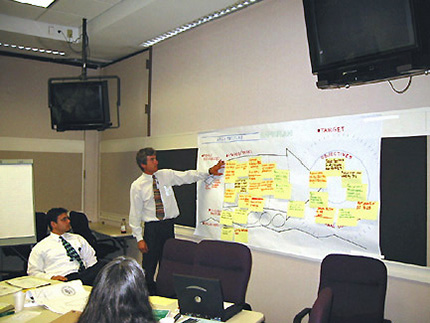
Charrette work groups use a graphic by The Grove Consultants International to visually capture short, mid, and long term action items, success factors, visions, etc. An example of the resultant graphic is shown below.
Photo Credit: ENSAR Group, Inc.
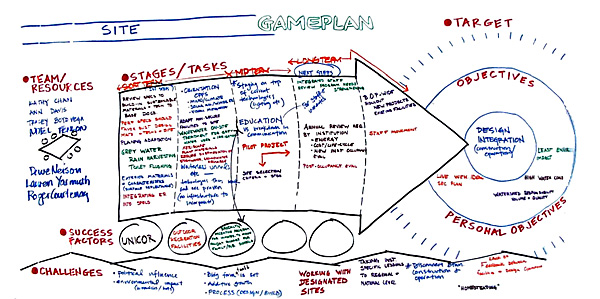
Image Credit: ENSAR Group, Inc.
Emerging Issues
There are several interesting emerging trends in ID Charrettes:
- First, sponsors are expanding the scope in terms of topics addressed and stakeholders/ participants. These charrettes might explore in greater depth topics such as the history and social fabric of the surrounding community and the hydrogeology and natural history of the area, with local community representatives participating.
- Second, others are using charrettes to address issues beyond buildings. For example, the National Park Service, the U.S. military services, and many university campuses are holding charrettes to develop plans for entire parks, base installations, or university campus operations relating to sustainability.
- Finally, many project teams are recognizing that charrettes should be part of an ongoing process, not one-time events.
Additional Resources
Organizations
Publications
- A Handbook for Planning and Conducting Charrettes for High-Performance Projects by Gail Lindsey, Joel Ann Todd, and Sheila J. Hayter, National Renewable Energy Laboratory.
- PBS-P100 Facilities Standards for the Public Buildings Service
- Integration at Its Finest: Success in High-Performance Building Design and Project Delivery in the Federal Sector by Renée Cheng, AIA, Professor, School of Architecture, University of Minnesota. Sponsored by the Office of Federal High-Performance Green Buildings, U.S. General Services Administration, 2014.
- Sample charrette final reports:
- Federal Bureau of Prisons
- Institute of American Indian Art Sustainable Futures Initiative
- National Park Service:
- Pine Jog Environmental Education Center
- UNC - Asheville New Science Building
Others
- Department of Energy, High-Performance Buildings Case Studies