Introduction
Within This Page
Windows have long been used in buildings for daylighting and ventilation. Many studies have shown that health, comfort, and productivity are improved due to well-ventilated indoor environments and access to natural light. However, windows also represent a major source of unwanted heat loss, discomfort, and condensation problems. In 1990 alone, the energy used to offset unwanted heat losses and gains through windows in residential and commercial buildings cost the United States $20 billion (one-fourth of all the energy used for space heating and cooling).
In recent years, windows have undergone a technological revolution. High-performance, energy-efficient window and glazing systems are now available that can dramatically cut energy consumption and pollution sources: they have lower heat loss, less air leakage, and warmer window surfaces that improve comfort and minimize condensation. These high-performance windows feature double or triple glazing, specialized transparent coatings, insulating gas sandwiched between panes, and improved frames. All of these features reduce heat transfer, thereby cutting the energy lost through windows.
This Resource Page covers basic concepts for specifying window and glazing systems, particularly energy-efficient windows.
Description
Window systems are comprised of glass panes, structural frames, spacers, and sealants. In recent years, the variety of glass types, coatings, and frames available for use in window systems has increased dramatically, as has the opportunity to fine-tune and optimize window selection on a project-by-project basis.
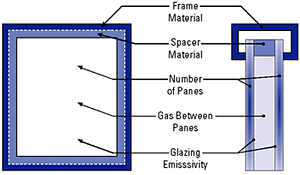
Factors affecting window performance.
Image Courtesy of Energy User News
Careful specification of window and glazing systems is essential to the energy efficiency and comfort of all buildings. In residential, skin-load dominated structures (such as housing) optimum window design and glazing specification can reduce energy consumption from 10%–50% below accepted practice in most climates. In internal-load dominated commercial, industrial, and institutional buildings, properly specified fenestration systems have the potential to reduce lighting and HVAC costs 10%–40%.
Window and glazing choices should be considered holistically. Once the design team and owner agree on the design problem, window and glazing options can be evaluated. Issues to consider include:
- Heat gains and losses
- Visual requirements (privacy, glare, view)
- Shading and sun control
- Thermal comfort
- Condensation control
- Ultraviolet control
- Acoustic control
- Color effects
- Daylighting
- Energy requirements
Ultimately, the optimum choice of window and glazing systems will depend on many factors including the building use type, the local climate, utility rates, and building orientation.
A. Specifying Windows and Glazings
To fully specify a window system, it is necessary to specify the following characteristics:
- Window U-value
- Window Solar Heat Gain Coefficient (SHGC), or shading coefficient (SC)
- Glass Visible Transmittance (Tvis-glass)
For specific aesthetic and performance objectives the specifier may also wish to specify:
- Tints (colors) and Coatings
U-Value
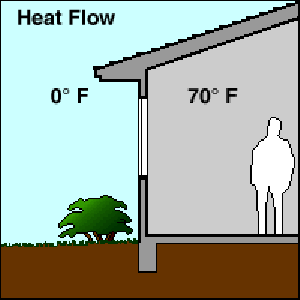
U-value indicates the rate of heat flow due to conduction, convection, and radiation through a window as a result of a temperature difference between the inside and outside. The higher the U-factor the more heat is transferred (lost) through the window in winter.
-
The units of U-value are: Btus per hour per square foot per °F (Btu/hr · ft² · °F)
-
U-factors usually range from a high of 1.3 (for a typical aluminum frame single glazed window) to a low of around 0.2 (for a multi-paned, high-performance window with low-emissivity coatings and insulated frames).
-
A window with a U-factor of 0.6 will lose twice as much heat under the same conditions as one with a U-factor of 0.3.
-
Total (or net) window U-factors can be considerably higher than the center-of-glass U-factors.
Solar Heat Gain Coefficient (SHGC)
SHGC indicates how much of the sun's energy striking the window is transmitted through the window as heat. As the SHGC increases, the solar gain potential through a given window increases.
-
The SHGC is a ratio between 0 and 1. SHGC = 0 means none of the incident solar gain is transmitted through the window as heat and SHGC = 1 means all of the incident solar energy is transmitted through the window as heat.
-
A window with a SHGC of 0.6 will admit twice as much solar heat gain as one with a SHGC of 0.3.
-
Typically, windows with low SHGC values are desirable in buildings with high air-conditioning loads while windows with high SHGC values are desirable in buildings where passive solar heating is needed.
-
The term "SHGC" is relatively new and is intended to replace the term "shading coefficient (SC)." While the terms are related, the shading coefficient of glass is defined as the ratio of the solar heat gain through a given glazing as compared to that of clear, 1/8 inch single pane glass.
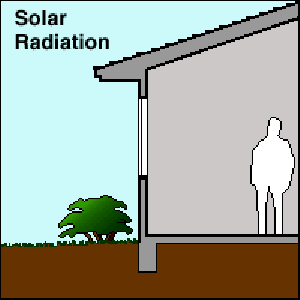
Solar Radiation
Courtesy of Efficient Windows Collaborative
Heat Flow
Courtesy of Efficient Windows Collaborative
Visible Transmittance (Tvis-glass)
Tvis-glass indicates the percentage of the visible portion of the solar spectrum that is transmitted through a given glass product.
-
Sunlight is an electromagnetic form of energy exchange between the sun and the earth. It is composed of a range of electromagnetic wavelengths, generally categorized as ultraviolet (UV), visible, and infrared (IR) referred to collectively as the solar spectrum.
-
The short, UV wavelengths are largely invisible to the naked eye, but are responsible for fabric fading and skin damage. Visible light is made up of those wavelengths detectable by the human eye. This light contains about 47% of the energy in sunlight. Longer IR wavelengths are also invisible and contain about 46% of the energy in sunlight.
-
For a given glazing system, the term "Coolness index (Ke)," also called Efficacy Factor, is the ratio of the Tvis-glass to the shading coefficient (SC).
Tints (Color) and Coatings
The properties of a given glass can be altered by tinting or by applying various coatings or films to the glass.
-
Glass tints are generally the result of colorants added to the glass during production. Some tints are also produced by adhering colored films to the glass following production.
-
Tints are usually selected for aesthetic purposes. Some tints also help reduce solar gains.
-
Coatings, usually in the form of metal oxides, can also be applied to glass during production. Some of these coatings, called "low-emissivity" or "low-e," help reduce radiant heat transfer between panes of glass by blocking some or all of the IR wavelengths. These coatings can dramatically lower the window U-factor.
-
Care should be taken in specifying tints and coatings, as their application can dramatically impact window heat loss and heat gain. Mis-specification can result in the exact opposite of the desired performance.
-
From a performance perspective, specifying window U-factor, SHGC and Glass Visible Transmittance (Tvis-glass) means there is no need to specify tints and coatings.
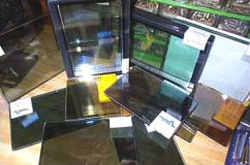
There are far more glazings available for buildings today than there were even a few years ago.
Some recommendations for specifying windows and glazings include:
-
In general cases, specify low U-factors (< 0.40) for residential applications. Even lower values may be desired in extreme heating climates.
-
When specifying windows performance, take care to specify "whole product performance values" for U-factor and SHGC. Use of "glass-only" U-factors should be avoided as they can be 10% to 40% better than the whole product value.
-
In climates with significant air conditioning loads, specify windows with low SHGC values (< 0.40).
-
In general, high (> 70%) Glass Visible Transmittance is desired, especially for daylighting applications.
-
For commercial buildings in conjunction with daylighting strategies, analyze the trade-offs between standard glazing and high coolness index (also called spectrally selective) glass. Spectrally selective glass has a relatively high visible transmittance and a relatively low SHGC.
-
In general, low SHGC windows should be considered for east- and west-facing glazing as a means of controlling solar heat gain and increasing occupant comfort. For large commercial and industrial structures, specify low SHGC windows on the east, south, and west facades. SHGC for north-facing windows is not critical for most latitudes in the continental United States.
-
For buildings where passive solar heating energy is desired, south-facing windows with high SHGC values coupled with low U-factors should be specified.
-
Select windows with comfort in mind. The proper specification of windows can result in higher Mean Radiant Temperature (MRT) in winter and lower MRT in summer, improving occupant comfort and productivity. MRT represents the average temperature an occupant feels from radiant heat exchange with their surroundings.
B. Representative Glass Specifications
| Glass Type (Product) | Glass Thickness (Inches) | Visible Transmittance (% Daylight) |
U-factor (Winter) | Solar Heat Gain Coefficient (SHGC) |
|---|---|---|---|---|
| Single Pane glass (standard clear) | 0.25 | 89 | 1.09 | 0.81 |
| Single White Laminated w/Heat Rejecting Coating (Southwall California Series®) |
0.25 | 73 | 1.06 | 0.46 |
| Double Pane Insulated Glass (standard clear) | 0.25 | 79 | 0.48 | 0.70 |
| Double Bronze Reflective Glass (LOF Eclipse®) |
0.25 | 21 | 0.48 | 0.35 |
| Triple Pane Insulated Glass (standard clear) | 0.125 | 74 | 0.36 | 0.67 |
| Pyrolitic Low-e Double Glass (LOF Clear Low-e®) |
0.125 | 75 | 0.33 | 0.71 |
| Soft-coat Low-e Double Glass w/Argon gas fill (PPG Sungate® 100 Clear) |
0.25 | 73 | 0.26 | 0.57 |
| High Efficiency Low-e (Solarscreen 2000 VEI-2M™) |
0.25 | 70 | 0.29 | 0.37 |
| Suspended Coated Film (Heat Mirror™ 66 Clear) |
0.125 | 55 | 0.25 | 0.35 |
| Suspended Coated Film w/ Argon gas fill (Azurlite® Heat Mirror SC75) |
0.125 | 53 | 0.19 | 0.27 |
| Double Suspended Coated Films w/ Krypton (Heat Mirror™ 77 Superglass) |
0.125 | 55 | 0.10 | 0.34 |
|
Performance information was calculated using Lawrence Berkeley National Laboratory WINDOW computer analysis program |
||||
C. Other Attributes
Other important attributes of window and glazing systems include:
-
Gas Fills—Inert gases such as argon and krypton are often injected between panes of glass to reduce conductive and convective heat transfer. These low-cost, gas fills reduce U-values without affecting shading coefficients or visible transmittance.
-
Fritting—Baked on ceramic coatings, or frits, can be applied to the surface of glass in many different patterns, colors, and densities.
-
Safety and Security Glass—Information on the applications and benefits of laminated architectural glass can be found here. For specific information, visit the websites of the Manufacturers listed under Additional Resouces on this page.
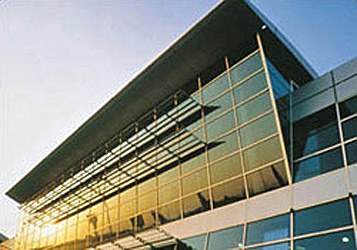
International terminal building in Istanbul's Ataturk Airport uses laminated glass for safety and security
Photo Courtesy of DuPont Laminated Technologies
-
Retrofit Films—For information on the pros and cons of retrofit films, visit Florida Solar Energy Center.
- Switchable Optics—A new generation of dynamic glazings are available that change optical properties through changes in light, temperature, or voltage (i.e., photochromic, thermochromic, electrochromic.) Currently, these materials are economically viable for niche markets only, such as two-way mirrors.
- For more information on switchable glazings see Pacific Energy Center Factsheet—Switchable Glazings and DOE's Energy Saver—Window Types. For information on the general state of fenestration research contact Lawrence Berkeley National Laboratory's Windows & Daylighting Group.
D. Opportunities and Cautions
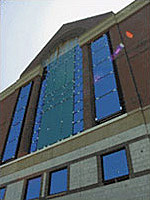
Through its loan program, NYSERDA helped the Capital District Train Authority install new, energy-efficient glazing and high-efficiency heating and cooling equipment at this train station in Rensselaer, New York.
Photo Courtesy of NYSERDA
Some design opportunities and cautions concerning the specification and application of window and glazing systems include:
Opportunities
-
Using high-performance windows can dramatically reduce heating and cooling loads, and eliminate the need for perimeter heating in internal-load dominated buildings due to the effect of increased Mean Radiant Temperature (MRT) on occupant comfort (see High-Performance HVAC).
-
Window systems with low-e and spectrally selective coatings can filter damaging UV wavelengths and increase the life of room furnishings.
-
Optimized fenestration systems for passive heating in residential buildings or for daylighting in commercial/industrial buildings will reduce loads and save O&M costs.
Cautions
-
Always specify certified, whole product energy performance values.
-
All low-e coatings are not the same! If selective coatings have been identified as a strategy to increase performance, make sure the coating is fully and properly specified for your application.
-
Always consider glare control, especially in commercial and industrial applications. Limiting contrast ratios and providing visual comfort in the field of view is critical, particularly in daylighting applications.
-
Avoid condensation problems. Condensation occurs when the glass surface temperature falls below the dew point of the room air. It can damage window and wall elements and obstruct views.
- Historic buildings often require special window detailing. The desire to achieve historical accuracy can sometimes conflict with the desire to provide energy efficiency. Fortunately, several companies are now offering high-performance products that can replicate the appearance of historical windows while maintaining energy efficiency.
Application
Case Study
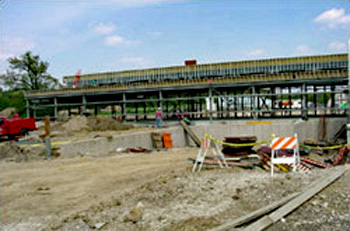
Argonne National Laboratory—Argonne, Illinois
The State of Iowa Facilities Improvement Corporation (SIFIC) and the Mental Health Institute in Independence, Iowa joined forces to identify and implement energy management improvements. Among several strategies, the team installed more than $300,000 worth of energy-efficient windows. To date, the Institute has saved more than $100,000 annually in energy costs.
Argonne National Laboratory, Argonne, Illinois, is one of DOE's first buildings to pursue LEED certification by the U.S. Green Building Council. The design includes more than 15 building materials chosen for their recycled, renewable, or lower-emitting content. In addition, several energy conservation features, such as high-performance windows selective to west and north orientations, will reduce electric consumption by 20% and natural gas by 30%, lowering the building's greenhouse gas impact by 55 tons/year. More
Relevant Codes and Standards
- ASHRAE Handbook of Fundamentals by American Society of Heating, Refrigeration, and Air-Conditioning Engineers
- Energy Policy Act of 2005 (EPACT)
- Energy Star® Windows
- National Fenestration Rating Council (NFRC) Certified Products Directory—Contains performance characteristics for window assemblies from most manufacturers.
Additional Resources
Associations and Organizations
- American Architectural Manufacturers Association (AAMA)—Trade association of firms engaged in the manufacture and sale of building fenestration components and related products.
- Efficient Windows Collaborative—Provides information on the benefits of energy-efficient windows in houses throughout the US. This site is sponsored by the U.S. Department of Energy.
- Florida Solar Energy Center—Fenestration Research Group—This group studies the performance of fenestration systems. The main focus is on solar heat gain and its effects on energy costs for heating and cooling.
- National Fenestration Rating Council (NFRC)—A non-profit public/private collaboration of manufacturers, builders, designers, specifiers, code officials, consumers, utilities, and regulators working towards a national energy performance rating system for fenestration products.
- National Glass Association
Design and Analysis Tools
Window Properties
- Energy Star® Windows
- Usually, the physical properties of glazing systems are easily obtained from product literature and certified by the National Fenestration Rating Council (NFRC).
- WINDOW, a federally funded computer program developed by Lawrence Berkeley National Laboratory (LBNL), calculates U-values, SHGC, and Tvis of window systems constructed from glass and frames of known properties.
Window Design Strategies
Commercial and Institutional—To analyze the effect of different window areas and glass properties, investigate the following:
- Computational Fluid Dynamics (CFD)—This advanced computer-based analysis method can help analyze the effects of complex fenestration systems on air currents and interior ventilation patterns. For more information: CFD Online
- DOE-2— hourly building simulation software designed to analyze, complex, multi-zone buildings.
- eQuest®—replacement to PowerDOE.
- Skylight Handbook—A hand calculation method for optimum skylight design developed by Lawrence Berkeley National Laboratory (LBNL). Available from AAMA (Product Code SHDG-1-88).
Other
- GSA Sustainable Facilities Tool (SFTool)—SFTool's immersive virtual environment addresses all your sustainability planning, designing and procurement needs.
Publications
- Glazing Design Handbook for Energy Efficiency by The American Institute of Architects (AIA). Washington, DC, 1997.
- Residential Windows: A Guide to New Technologies and Energy Performance by John Carmody, Stephen Selkowitz, Dariush Arasteh and Lisa Heschong. New York: W. W. Norton & Company.